> For the complete documentation index, see [llms.txt](https://help.timelygrader.ai/llms.txt). Markdown versions of documentation pages are available by appending `.md` to page URLs; this page is available as [Markdown](https://help.timelygrader.ai/self-serve-support-articles/17.-refining-results-in-timelygrader-a-practical-guide.md).
# 17. Refining Results in TimelyGrader: A Practical Guide
Quick ways to make AI grading suggestions and feedback more accurate, relevant and closely aligned with your expectations.
Results are rarely perfect on the first try. These tweaks bring AI grading suggestions and feedback closer to how you grade.
## Steps
{% stepper %}
{% step %}
### Always start with a baseline (even if it's not accurate)
Upload the assignment and rubric with minimal edits to see how TimelyGrader interprets them. Accuracy doesn't matter yet.
The grading explanations next to each suggested grade show you where the system struggles:
* Vague wording in the rubric
* Criteria that don't state their intent
* Missing context that lives in separate documents
* Hallucinations or misinterpretations
Finding these errors is the first step.
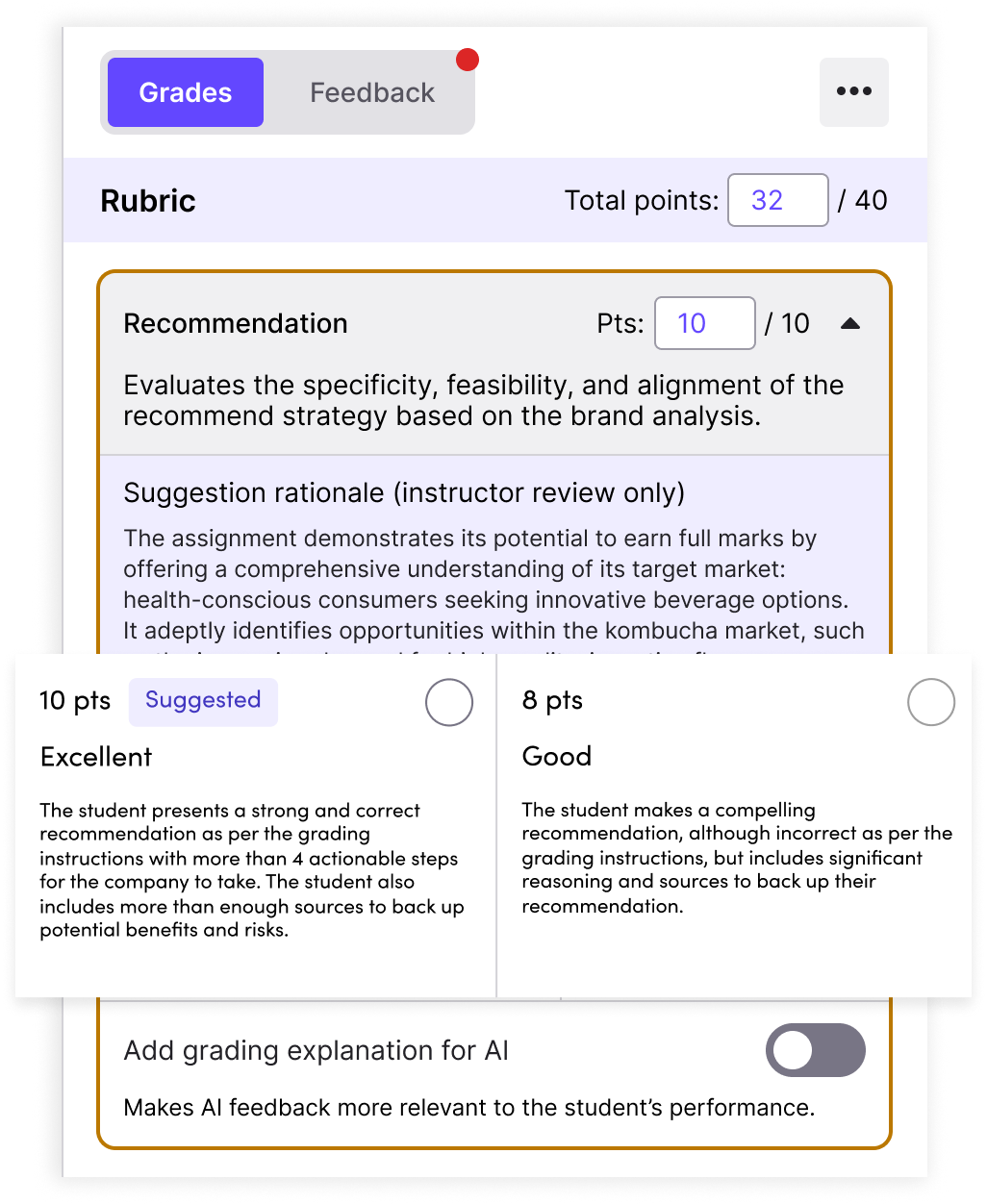
**Example:** A "Recommendation" criterion with undefined ratings (such as "Good") forces the system to guess, and the guess often misses your expectations.
{% endstep %}
{% step %}
### Identify what needs adjustment
**a) Update the rubric**
* Add clear performance descriptions for each rating level.
* Replace vague phrases with measurable indicators.
* Add criteria that reflect your current priorities.
**Example:**
* **Before:** "Excellent Recommendation — Presents a strong recommendation with relevant sources."
* **After:** "Excellent Recommendation — Presents 3 clear, evidence-based, and actionable recommendations that use relevant sources to support key claims."
**b) Add specific grading instructions**
* Add notes on special cases as grading instructions, without revealing answers to students.
* Use direct rules to settle ambiguity, such as partial credit, formatting issues or acceptable sources.
**Example:** "If the student does not make this particular recommendation to the case study, do not provide full marks regardless of the recommendation." The AI will then only give full marks when students make that recommendation to the company.
{% endstep %}
{% step %}
### Iterate and regenerate
Reset the submissions, apply the updated rubric or instructions, and regenerate to measure the improvement. Repeat in small cycles until the results match your standards.
**Example:** With clearer descriptors and rules, the AI separated "excellent" from "good" recommendations. Excellent required the correct recommendation with more than four actionable steps and ample sources on benefits and risks. Good was compelling and well reasoned but didn't match the grading instructions.
{% endstep %}
{% step %}
### Only you know how you grade
AI refinement works best alongside your subject expertise. Use the AI to spot patterns and inconsistencies, then decide whether the cause is vague rubric language or missing context.
**Example:** A writing instructor found the AI too lenient on grammar and revised the rating descriptions so higher grades were harder to earn.
{% endstep %}
{% endstepper %}
## Bottom line
TimelyGrader isn't full automation. It works like a teaching assistant that you train and that improves with your refinements. Clearer instructions help it reflect your academic judgment, saving you time while maintaining quality.
## Related articles
* [Advanced: Customizing Grading](https://help.timelygrader.ai/self-serve-support-articles/15.-advanced-customizing-grading.md)
* [How to Reset Grades and Feedback](https://help.timelygrader.ai/self-serve-support-articles/10.-how-to-reset-grades-and-feedback.md)
* [Regeneration for More Accurate Feedback](https://help.timelygrader.ai/self-serve-support-articles/18.-regeneration-for-more-accurate-feedback.md)